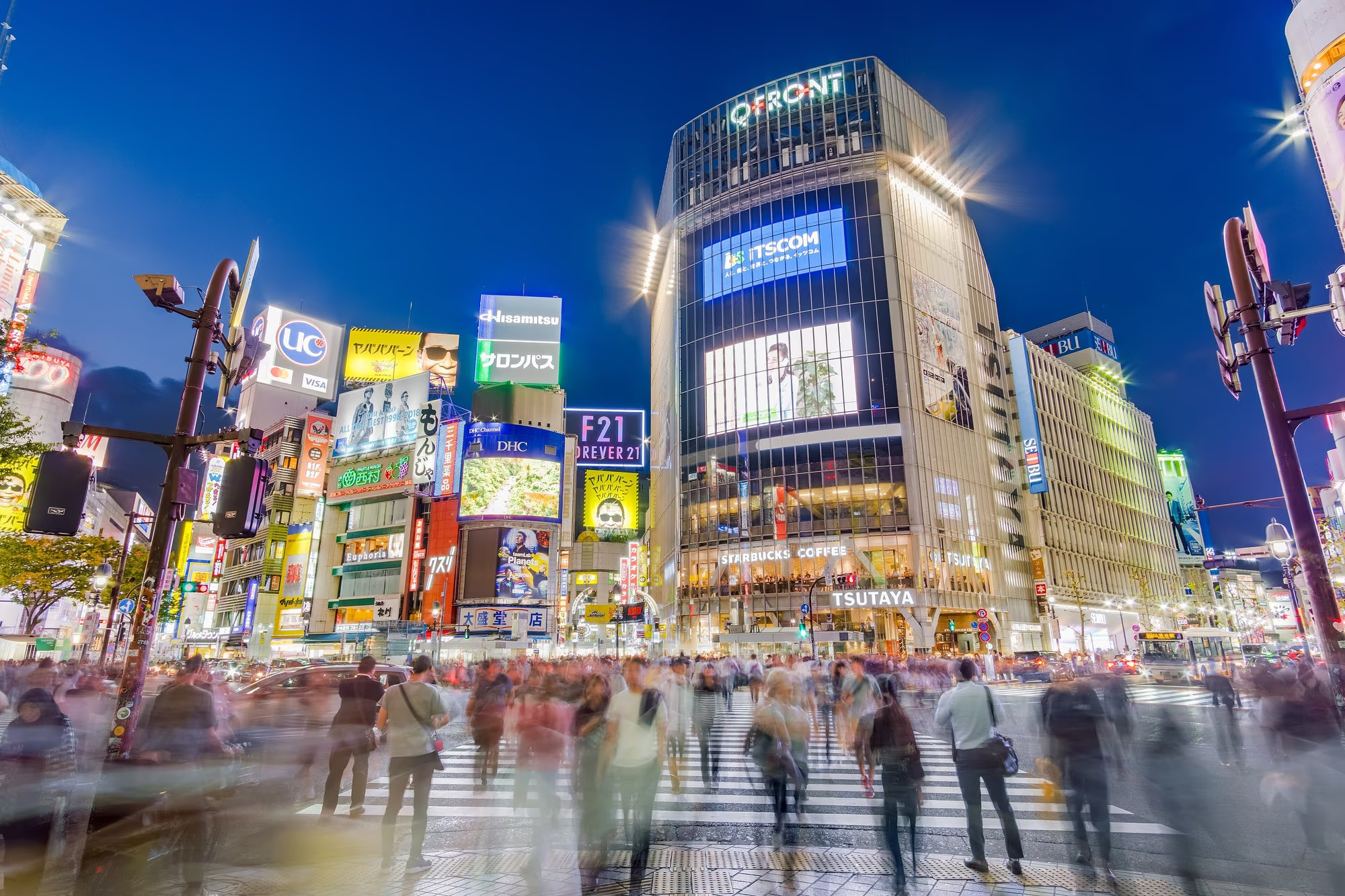
The Shibuya Crossing is both the starting point of any visit to the district and the thing most often misunderstood. It is not somewhere you go to look at. It is somewhere you walk through.
What makes it different
Busy intersections exist everywhere. Three conditions overlap here.
1. Five crossings go green together. All traffic stops and only pedestrians move. Diagonals are allowed, so the flow becomes a mesh rather than a set of parallel lines.
2. The density is on another scale. Shibuya Station is a huge terminal served by several operators, and its exits feed straight into this junction. Everyone who comes through the gates arrives here at once.
3. Giant screens surround it. Almost every building face around the intersection is a video display. After dark they are the light source. That visual density is what people mean by “Shibuya”.
Where it is and how to get there
The Crossing is directly outside the Hachikō exit of Shibuya Station. Come through the JR Hachikō ticket gates and you are already standing on one corner of it.
Shibuya Station has a large number of exits and first-time visitors do get lost. What to do if you come out somewhere else is covered in getting there. Signage for the Hachikō exit is posted from every direction, which makes it the reliable fallback.
The hour changes everything
Weekday 08:00–09:30 — The commuter rush. Maximum density, but everyone is moving fast, so there is little standing about. This is the “river of people” shot.
Weekday 11:00–16:00 — The easiest time to move. Good for combining with shopping or lunch; photographically unremarkable.
Weekday 18:00–19:30 — The evening rush overlapping with the signage coming on. The single best window. High density and darkening sky, so the screens take over.
Weekend afternoons — Shibuya as a youth district is most visible now: clothes, groups, atmosphere. Movement is slower.
After 23:00 — Foot traffic continues past the last trains. Fewer people, but the screens stay lit. Long exposures are not practical, but a quieter Shibuya is its own picture.
Looking down versus walking through
There are two ways to experience it, and both are worth doing.
Walking through — When the lights change, people flood in from all four sides and you end up surrounded. That subjective experience does not exist from above. Use the diagonal and you pass through the centre.
Looking down — The flow becomes a pattern. Free: the walkway above the station gates. Paid: MAG8, the rooftop of MAGNET by SHIBUYA109, for a near-overhead angle. From Shibuya Sky at 229 m the Crossing is small, but the whole district is in frame.
Every viewpoint is compared in where to watch the Crossing.
What sits around it
Almost everything is within a five-minute walk of the intersection.
- Hachikō statue — east side, in the station forecourt. Shibuya’s best-known meeting point
- Center-gai — north-west. A pedestrian street packed with food and clothing
- SHIBUYA109 — west, at the foot of Dōgenzaka. The landmark of youth fashion
- Shibuya Scramble Square — east, connected to the station. Shibuya Sky occupies 46F and the roof
- MAGNET by SHIBUYA109 — north side. MAG8 is on its roof
- Miyashita Park — five minutes north-east. A rooftop park over a retail and dining complex
- Shibuya Hikarie — east exit. Exhibition space and restaurants
That compactness is Shibuya’s real strength. Half a day covers all of it on foot.
Doing the Crossing as part of a tour
You do not need a guide to cross a road. But the back lanes and yokocho alleys around it are a different matter — what you see there depends heavily on whether someone shows you.
Shibuya walking tours typically start at the Crossing and take in the lanes behind Center-gai, Nonbei Yokocho and Miyashita Park. Evening versions sometimes include observation-deck entry. See tours and guides.
There is also an open-top double-decker bus route around the district, which passes through the intersection at road level — a perspective you get neither on foot nor from a deck.
Things to get right
- Keep moving. Standing still in the middle stops the people behind you
- No tripods. They obstruct the crossing
- Ignore the touts. Particularly at night towards Dōgenzaka
- Mind your bag. Dense crowds mean pickpocket risk
- Check before Halloween. Shibuya City restricts street drinking near the station. See Halloween in Shibuya
Common misconceptions
“There’s an entrance fee.” There is not. It is a public road. Only the viewpoints above it charge.
“The Hachikō statue is in the middle of the crossing.” It is outside it, in the station forecourt.
“Go to Shibuya Sky and you’ll get a great shot of the Crossing.” You will get a great shot of Shibuya. The Crossing itself will be small. MAG8 or the station walkway are better for that.
“It’s empty late at night.” It is not. Foot traffic never really stops.
Sources
MAG8 opening hours come from the official MAGNET by SHIBUYA109 page and Shibuya Sky details from the official Shibuya Scramble Square site, both checked on 3 September 2026. For the street-drinking ordinance near Shibuya Station, see Shibuya City’s ordinance page.
Pedestrian counts differ between sources and methods, so this page gives ranges rather than a single figure.